Memory Complex Update
Korean margin debt broke the tape while estimates kept rising. What forward multiples actually assume, and where the entry logic stands.

The memory complex has lost roughly $1.3T of market value since early July. Micron sits 26% below its peak, SK Hynix 27%, Samsung 20%, SanDisk 38%, with Western Digital , Seagate, and Kioxia down comparable amounts. Over the same three weeks, consensus earnings estimates rose for every company in the group, and the sell side continued revising upward through the worst sessions of the decline. A drawdown of this size against rising estimates admits only two explanations. Either the market has started discounting an estimate rollover it expects but cannot yet document, or the selling originated somewhere other than fundamental judgment. The evidence supports the second: a record concentration of Korean retail leverage in Samsung and SK Hynix started unwinding on July 13, and the structure of that leverage converted two manageable headlines into a cascade.
Establishing which explanation is correct matters more than usual, because the two imply opposite actions at current prices. If this is the market front-running an estimate peak, the multiples below are a trap. If it is a mechanical deleveraging, the fundamental case has not yet been tested at all, and the test dates are already on the calendar. Working through the leverage data, the revision record, and what the current multiples embed gets you most of the way to an answer. Where the selling came from: Here’s the sequence. On July 10, SK Hynix listed on NASDAQ, the kind of maximum-accessibility event you tend to find near tops. On July 13, a Korean broker put out a Q2 preview about 8% below consensus, blaming slower HBM4 shipments, and Hynix fell 15.4% in Seoul, reportedly its worst day in 18 years. A bounce on the 15th, then on the 16th China’s CXMT, the world’s #4 DRAM maker, filed an $8.6B Shanghai IPO, and everything fell 5–11% again.
A broker note and an IPO filing don’t erase $1.3T. What did the erasing was the leverage stacked underneath the rally, most of it in Korea. Korean margin debt hit a record ~₩38T (about $25B) this month, and roughly 28% of it sits in just two stocks, Samsung and Hynix. Hynix’s margin balance grew about fivefold in six months. On top of that, retail money poured into 2x and 3x single-stock ETFs on the two names, and those products ballooned from ₩4.4T to over ₩15T in the single month before the top, with 92% of the money retail. When the tape turned, the machine ran in reverse: around 1.2M accounts hit margin-call thresholds and something like 320,000 to 360,000 were forcibly liquidated. Press coverage settled on a memorable stat, roughly one in thirty Koreans got a margin call.
Then the institutions made it self-reinforcing. Brokers raised initial margin on the two stocks from 20% to anywhere between 30% and 60%, which forces deleveraging no matter what anyone believes. The regulator halted new leveraged-ETF listings, tripled the cash deposit to trade the existing ones, and banned advertising them. Read that carefully: the marginal buyer of the last ₩10T of Korean chip exposure was levered retail, and that buyer has now been regulated out of existence. Daily-rebalance leveraged ETFs sell more as prices fall. Margin hikes force sales regardless of view. That’s why the tape has been printing -15%, +9%, -11% on consecutive days. Until this leverage clears, price action in the Korean names is measuring collateral stress more than business fundamentals.
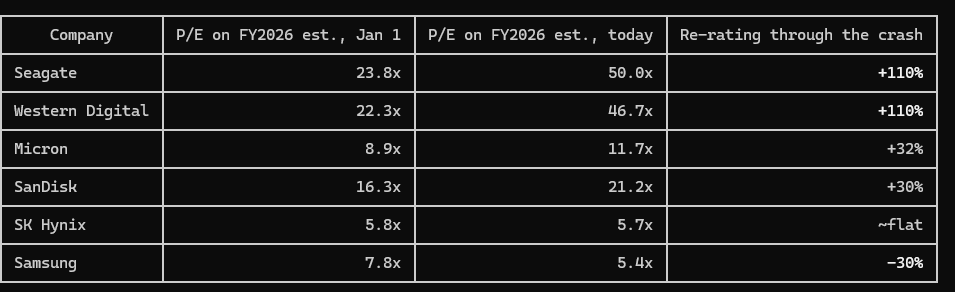
Meanwhile, the numbers went the other way. While all this was happening, Micron’s current-year EPS estimate (the fiscal year ends in six weeks) went from $32 in January to $73 now. SanDisk’s went from $15 to $67. Thirty-plus analysts per DRAM name are still revising up; Micron’s tally is 37 up, 1 down. In January the market paid about 9x Micron’s forward-year estimate. Today it pays 5.6x next year’s number. Memory cycles have a reliable tell: the stocks top when estimate revisions roll over, not when prices wobble. By that rule, this top isn’t confirmed, or even really indicated. The one amber light worth respecting is that Hynix and Samsung each just logged their first four down-revisions of the entire cycle. That’s how every rollover starts, tt’s also statistical noise among 40 analysts, both things are true, which is why the next two weeks matter so much.
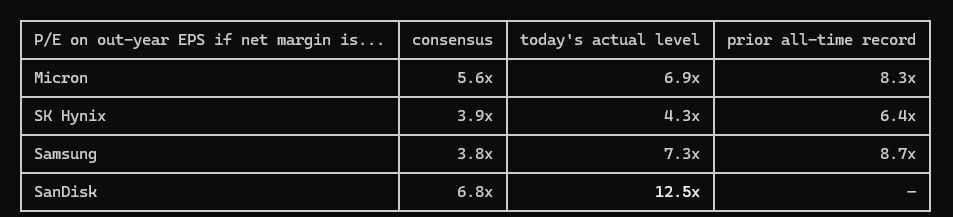
So the sellers were forced and the estimates are rising. Easy buy? I took consensus out-year EPS, multiplied by actual share counts, and divided by consensus revenue, which gives you the net margin these estimates implicitly assume. Then I put it next to what each company actually earns today and its all-time record from the 2018 cycle:
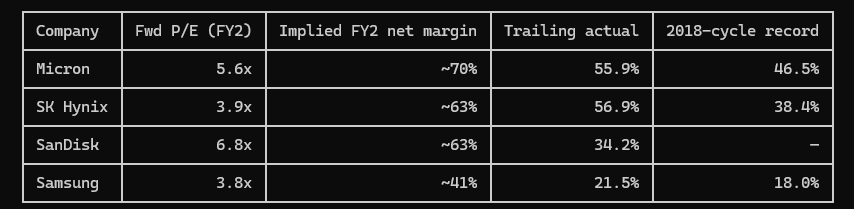
Two honest observations. First, the bulls have already won an argument most people thought they’d lose: current margins are running about ten points above the old all-time records. HBM really did change the industry’s economics, and anyone who spent the last year insisting memory always mean-reverts has been wrong the whole way up. Second, consensus is now extrapolating past its own proof. Micron’s out-year embeds roughly 70% net margins, fourteen points above the current record level, on revenue that nearly doubles, which works out to something like $173B of net income from one company. SanDisk’s estimates assume margins go from 34% today to 63% in the fiscal year that starts this month, in NAND, the half of memory with no contract lock-in and the fastest historical supply response. The spread on SanDisk’s out-year EPS runs from $154 to $396; a range that wide is an admission that nobody covering the stock has real visibility. It isn’t an inefficiency that forty buy-rated analysts somehow missed. The market is pre-discounting numbers it suspects are peak. If record margins hold while volume doubles, these are the cheapest large caps in the world. If margins merely settle back to the old record, out-year EPS is about a third too high, today’s 5.6x is really 9x on falling estimates, and every memory top in history looked cheapest at exactly that moment.
The complex is three different trades wearing one narrative. The HBM DRAM names (Micron, Hynix, Samsung) are the only tier I want to own. Contracted HBM makes next year’s numbers partially booked rather than forecast, which is why the revisions keep coming. Within the tier, Micron is the clean near-term vehicle for one specific reason: it carries none of the Korean margin-debt overhang. Hynix and Samsung are fundamentally cheaper, but their local lines trade on collateral math until the deleveraging exhausts, and forced selling doesn’t stop at fair value. It stops when the leverage is gone. The NAND pure-plays (SanDisk, Kioxia) I’d leave alone after 20–30x runs, given a supply response hits NAND first and the embedded margin assumptions are the most aggressive in the group. The HDD names (WDC, STX at 25–26x forward on +29% revisions) have the most multiple risk and the least estimate support. My judgment is this pullback is buyable in the DRAM tier, through Micron first, and it is a trade until proven otherwise.