

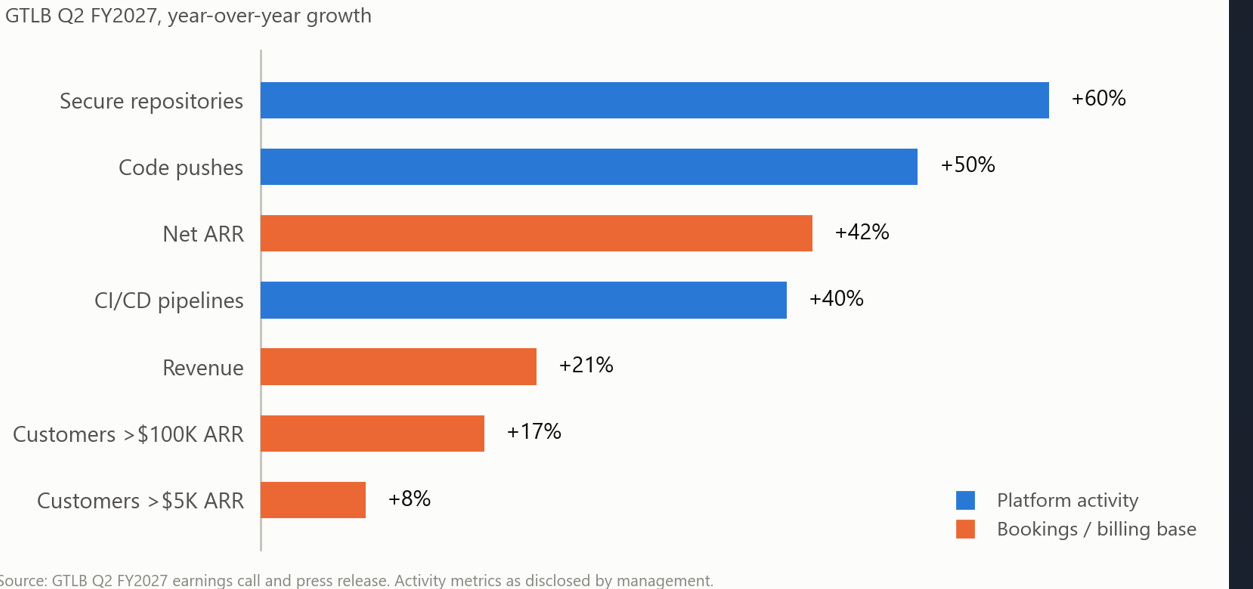
GTLB looked attractive in the mid $20s back in April, under 3x trailing revenue, when the tape had decided that a company cutting 14% of its workforce and exiting 22 countries mid-restructuring was telling you something about demand. It’s quoted around $56 pre-market this morning, up roughly 26% on the Q2 print. The quarter was excellent, and excellent for the right reasons. Revenue of $286.3M grew 21% YoY and beat the guide’s high end by $12.3M. Non-GAAP EPS of $0.24 came in 34% above consensus. Net ARR grew 42%, management’s second-best quarter in four years. First orders more than doubled, deals over $500K grew more than 150%, and calculated billings grew 24% against 12% last quarter. SMB and mid-market, the segment whose deterioration was the entire bear case, stabilized ahead of plan. I’m selling the whole thing today. The thing that got re-rated this morning isn’t the thing that got proven, and what GTLB had to do to its own pricing model to keep growing is the reason.
The bookings inflection holds up in the filing
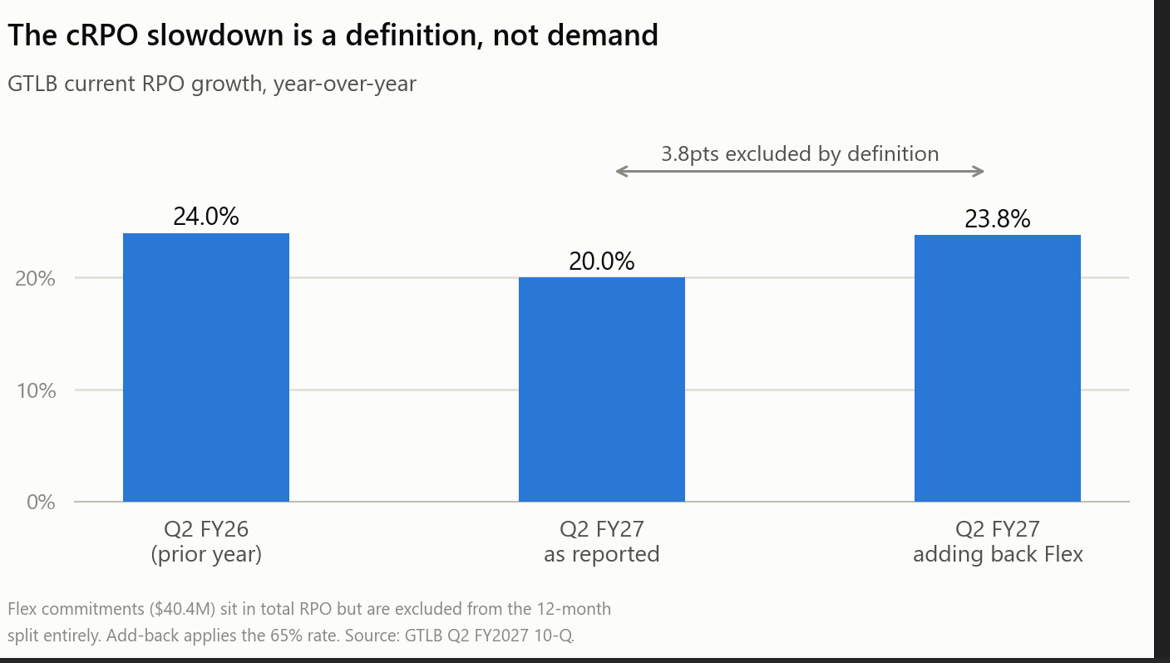
cRPO grew 20%, down from 24%. Looks like the deceleration story surviving the quarter. It isn’t. Flex, the new commercial model, creates a dollar commitment customers allocate later, and since the customer controls timing and product mix, those dollars are excluded from the cRPO calc entirely. The 10-Q filed this morning sizes it: $40.4M of non-cancellable Flex commitments sit inside total RPO and outside the 12-month split, $15.0M of it already billed and parked in customer advances rather than deferred revenue. Add it back at the same 65% recognition rate the footnote applies to everything else and cRPO growth is roughly 23.8%, against 24% a year ago. Flat, not decelerating. Worth checking whether RPO growth is instead being manufactured by longer contracts. It isn’t. The 12-month share of RPO was 65% at July 31, against 63% a year earlier and 64% the year before, and implied duration has sat around 1.6 years across all three. Total RPO growth of 16% is clean, which at a lot of software names it isn’t. The demand is real, and that part of the thesis worked.
What got re-rated is what’s hard to measure
Paid consumption run rate went from $15M exiting Q1 to over $40M exiting Q2, against a target of $100M-plus by year end. Flex signed 130-odd customers and over $20M of commitments in six weeks. That’s what the stock is being marked up on, and it’s the number I can’t verify. Two analysts asked the question that matters. UBS asked whether customers converting to Flex are upsizing or just changing the form factor. U.S. Bancorp asked how much of the $100M target is new products versus redirected seat spend. Both got “too early to tell.” BofA’s Koji Ikeda asked the sharpest version, whether the guide would’ve been $13M higher without the Flex rev-rec shift. The CFO walked through the guidance philosophy and didn’t answer it.
Management described the substitution mechanism themselves. Bill Staples, on how the sales team uses Flex: it lets them approach customers with unused capacity “who were previously forced to commit to a seat forecast for the full year, and rather than take some contraction on the account, keep their commitment the same or even higher, and redeploy that budget onto new consumption-based products.” Read that as a revenue-quality statement rather than a sales-motion statement. The shelfware GTLB used to bill for is now money the customer can point somewhere else.
How this actually falters
GTLB’s billing unit is a human seat, and the whole land-and-expand engine was built on it. More than half of the current $1B-plus run rate came from customers whose first order was under $5,000, and those cohorts compounded by adding developers. Agents break the link that engine runs on. Staples said on this call they’re re-architecting Git infrastructure for “roughly 100x scale what humans have ever required,” because one engineer now invokes “dozens and sometimes hundreds of agents.” Take him at his word. If work per engineer goes up an order of magnitude, the volume flowing through the platform decouples from the headcount they charge for. Work goes up, seats don’t.
Flex is the answer to that, and Flex is also the admission. You don’t rebuild your commercial model in a quarter unless the old one stopped tracking the value you create. But look at what the fix trades away. A seat subscription is contracted, escalates annually, and is awkward to shrink, because cutting it means admitting you over-hired. A Flex pool is a dollar commitment the customer re-points every month across whatever they feel like using. GTLB is converting its most defensible revenue into its least defensible revenue and describing it, correctly, as customer-friendly. Every consumption transition in enterprise software has made revenue more honest and less predictable at the same time. The multiple for revenue a customer redirects monthly is lower than the multiple for revenue locked to a seat count, and that re-rate usually shows up the first quarter a pool gets pointed down instead of up.
Then there’s who owns the developer’s surface. The stated moat is context: Orbit, the graph tying code, pipelines, issues and deployments together so agents give better answers. The disclosed usage stat is that roughly 80% of Orbit query volume comes from customers wiring it to external agents, Claude Code and Codex. Management frames that as validation, and near term it is. Structurally it says GTLB is becoming the governed substrate underneath somebody else’s interface. The layer that owns the daily developer relationship gets to bundle, meter and price. The substrate gets called by API and paid like plumbing. Essential plumbing with real switching costs, sure. Not a 7.8x business. The competitive asymmetry follows. GTLB says it has one primary competitor and that its position is stronger than ever, which the win rates support. They don’t name it. It’s understood to be GitHub, which is to say MSFT. If the profit pool in this stack migrates to the agent layer, MSFT can price the repo at or near zero to win the agent seat, because for them the repo is a feature of a much bigger bundle. GTLB can’t, because the repo is the company. That’s not a claim about whose product is better. It’s about who can afford to give theirs away.
COGS moves the wrong way at the same time. GAAP GM fell 400bps this quarter to 84% from 88%, with cost of revenue up 60% against revenue up 21%. Management attributes that to SaaS mix rather than AI inference, and notes many customers bring their own models, so token cost often sits outside the GTLB agreement. Fair, and it’s the strongest part of their margin answer. But pipeline minutes, indexing and artifact storage are GTLB’s cost regardless of whose model runs. If the platform really is built for 100x machine scale, COGS scales with machine work while seat revenue scales with humans. Those 400bps are the first evidence of that scissors. None of this resolves inside a year, which is the point. Under 3x I was paid to sit through it. At 7.8x I’d be funding it.
What the price needs
SBC was $75.0M in the quarter, 26.2% of revenue, up from 23.0% a year ago. GAAP operating loss widened to $56.9M from $18.4M. OCF was negative $3.1M against positive $49.4M a year ago, and H1 OCF of $146.1M came in below last year’s $155.7M on 22% revenue growth. The buyback is running, roughly 3.5M shares, but it’s absorbing dilution rather than shrinking the count, and the FY27 guide assumes 172M weighted diluted shares against the 166M assumed a quarter ago. Then the multiple. The stock bottomed near 2.4x trailing revenue in April. At $56 it’s about 7.8x trailing and 7.3x the new FY27 guide, above where it’s traded at any point in the last year. TEAM sits near 7.2x on the same basis while converting growth into a 12% GAAP operating margin, versus GTLB’s negative 6%. ESTC, growing 15% against GTLB’s 18-19% guide, is at 4.9x. The growth supports a premium to ESTC. It doesn’t support a premium to TEAM while running a 35pt gap between GAAP and non-GAAP operating margin. My triangulation lands at 5.0-6.5x forward, call it $41 to $51, and the Street’s mean PT of $38.48 across 23 analysts was struck pre-print. Those PTs go up today mechanically, which is flow, not information.
I think the concern about Flex replacing seat revenue is fair, but I’m not convinced consumption revenue is necessarily less defensible.
If AI agents significantly increase the amount of testing, security, and deployment work, GitLab could capture spending that its seat model would have missed entirely. The question for me is whether Flex expands customer spending over time or simply preserves revenue that would otherwise have contracted.
I’d like to see this in the next few quarters.