
Application Software Earnings Preview: The Setup Into August

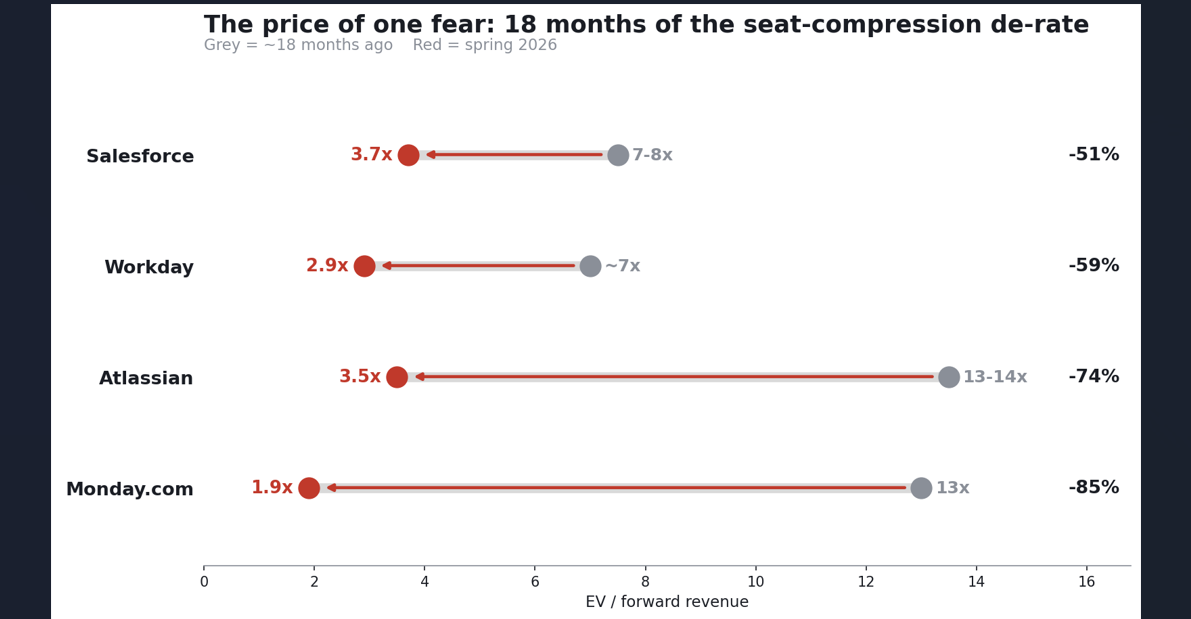
Eighteen months ago the market settled on a single story about application software, AI agents do the work, seats are the billing unit, so every seat-based vendor is a melting ice cube. That one fear did most of the damage to the group and Salesforce went from 7-8x forward revenue to 3.7x. Workday from roughly 7x to 2.9x. Atlassian from 13-14x to 3.5x. Monday.com from 13x to 1.9x. Call it a 50-70% de-rate, applied almost uniformly. If agents were eating seats, it would show up first in net revenue retention, customers renewing smaller, expanding slower, trimming licenses at every true-up. This spring, ten of these companies reported retention and expansion metrics in the same six-week window. The thesis failed the test at every single one so far.
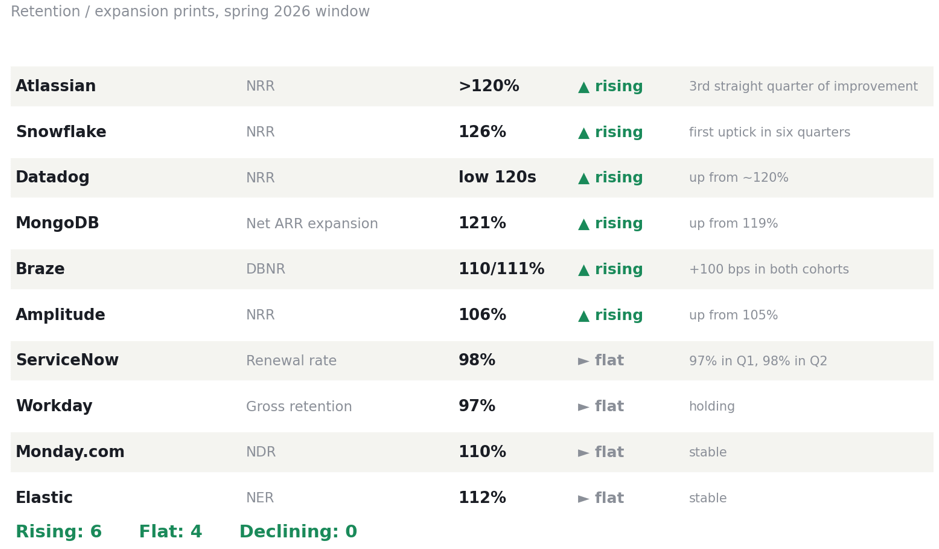
Atlassian printed NRR above 120% and rising, its third straight quarter of improvement. Braze’s dollar-based net retention ticked up 100 bps in both its cohorts, to 110% overall and 111% for large customers. Amplitude improved to 106% from 105%. Snowflake’s NRR turned up to 126%. MongoDB’s net ARR expansion went to 121% from 119%. Datadog’s NRR moved up into the low 120s. ServiceNow renewed 97% of its base in Q1 and 98% in Q2. Workday held 97% gross retention. Monday.com sat flat at 110%. Elastic sat flat at 112%. Rising at six, holding at four, declining at zero. A structural thesis that de-rates an entire sector should leave a mark in the one metric designed to catch it.
The vendors aren’t waiting to be disrupted
What makes the falsification more durable than one good quarter is that the companies are actively removing the short’s mechanism. ServiceNow disclosed that 50% of its net-new business is now non-seat-based tokens, infrastructure, connectors. Monday.com launched seats-plus-credits and got 10% of net-new ARR from credits in the launch quarter. Workday unified all of its AI monetization under Flex Credits. Braze renamed its unit action credits specifically to widen what it can bill beyond messages. Workday’s Bhusri put the argument in one line: “AI is replacing labor, not software... we’re a beneficiary of the shift to agentic work.” The AI revenue disclosures crossed from narrative to numbers in the same window the retention data held: Salesforce over $1B of Agentforce ARR, ServiceNow’s AI ACV crossing $1B against a target it already raised to $1.5B, Workday past $500M of AI ARR with agentic ACV up 200%, Atlassian’s Rovo customers expanding ARR at twice the rate of everyone else.
Most agent workflows don’t need a frontier model
There’s a second half to this argument, and it’s the one I set up from the other direction in the Kimi piece last week, the same force that terrified the market about software is turning into its input-cost subsidy. Same fact, opposite sign, depending on which side of the API you sit. Moonshot shipped Kimi K3 in mid-July as an open-weight model that trades punches with the Western frontier on capability and prices at parity with Claude Sonnet roughly $0.94 per task, against about $1.80 for the top Anthropic tier. A tier below that, DeepSeek will serve a task for around four cents. For a fixed level of capability, inference cost has fallen something like 95% in two years, and it is still falling. The good-enough middle of the intelligence market is deflating toward commodity pricing, and each release like K3 moves the “good-enough” line higher.
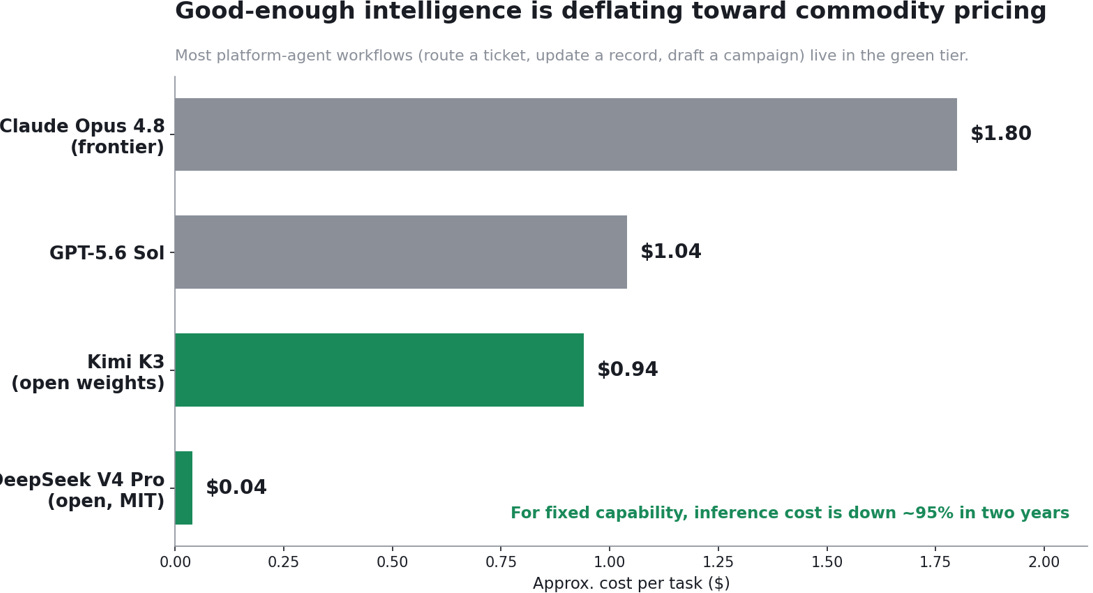
Now think about what the agents inside these platforms actually do all day. Route a ticket, triage an alert, draft a campaign, reconcile an expense report, update a record and summarize the case history. Almost none of that needs a frontier model. It needs a competent model with the right context, and the context is the thing the platform owns, not the lab. The frontier still earns its premium where reliability is the product (K3 got more capable and less trustworthy in the same release; its fabrication rate went from 39% to 51%), but a platform can route by task, frontier where a mistake is expensive, commodity where it isn’t. As the cheap tier gets smarter, more of the workflow slides down the price curve. Line that up against how these vendors just chose to price. Credits and tokens are sold to customers at fixed rates, while the model calls underneath are procured in a market deflating 90%-plus per unit of capability. That’s a widening spread, and the software vendor sits on the right side of it. The moat was never the model, it’s the proprietary data, the system-of-record status, the workflow lock-in and cheap open weights don’t erode any of that. They cut the COGS of every AI feature bolted on top of it. Which reframes the cohort’s ugliest prints. The market’s hardest punishment this spring went to visible AI cost, Amplitude’s minus 21% came partly from inference costs cutting the profit guide, Snowflake is absorbing gross-margin dilution on its AI products, Braze’s gross margin sits at 67.4% with AI in the COGS line. But an input cost that deflates this fast is a cyclical problem, not a structural one, and Elastic already showed the other side with a 70% token-cost reduction through retrieval engineering, in the same print where it raised its long-term margin target from over 20% to about 25%. Punishing the AI cost line right now is like penalizing an airline for its fuel bill in the middle of an oil crash.
When the backlog becomes revenue
First, the warning, because it’s where careless versions of this argument die, the metric has to be current RPO, not total. Total RPO is contaminated by contract duration. Snowflake’s total RPO grew 46-55% straight through a four-quarter revenue deceleration in fiscal 2025 as customers were signing longer deals, not consuming more. Atlassian’s headline RPO grew 38% this spring, but the share recognizing within twelve months collapsed from 78% to 69%, so on a current basis it grew about 22%, below its own revenue growth. The 10-Q footnote that splits RPO into current and non-current takes two minutes to read and is the difference between a signal and a duration illusion.
The same footnote answers a critical question most investors never ask: when does the backlog actually turn into revenue? Every 10-Q states what share of RPO recognizes within twelve months, and the answers across this group are wildly different. Workday recognizes only about a third of its book inside a year, a 3.1-year backlog, the longest here. ServiceNow recognizes 46%, a figure that hasn’t moved in a year; its RPO and cRPO both grew 21%, which is what a bookings print looks like with no duration games in it. Snowflake says about half, with the honest caveat that its estimate rests on historical customer consumption patterns, a forecast dressed as a schedule. Datadog says only that substantially all of it lands within 24 months. Customers signing longer deals is genuinely good for durability but also makes the headline RPO number overstate the next twelve months.
Now put the twelve-month piece of the backlog next to next year’s expected revenue and you get how much of the coming year is already contracted. Workday, about 85%. ServiceNow, high 70s. Salesforce, low 70s. Braze, roughly 70%. Elastic, around 60%. MongoDB, about 24% because most Atlas usage is pay-as-you-go and never enters RPO at all. That ratio is why the guide-beat table looks the way it does. When 85% of next year is signed, guiding is mostly arithmetic, which is why Workday lands within half a point of its number. When three quarters of next year depends on usage decisions customers haven’t made yet, management guides what’s contracted and lets consumption surprise to the upside nine straight beats of 3-7% at MongoDB. The conservatism isn’t discipline, it’s the un-contracted remainder showing up on schedule.
On the metric that matters, the picture is strong where it counts and soft in two named places. Braze’s cRPO accelerated to 28%. ServiceNow beat its own cRPO guide by 100 bps in Q1 and 200 bps in Q2. MongoDB’s cRPO grew 69% and that’s the number worth trusting, not the +88% total-RPO headline, which includes the duration extension. Elastic’s accelerated from 15% to 20%. The soft spots: Salesforce is flat at 13-14% with no acceleration, and Workday has faded from 17.6% to 15.5% still ahead of its revenue growth, but moving the wrong way. Those two get named because the mechanism only deserves your trust if it’s applied both ways.
One last caveat, the bookings signal only pays when the expansion rate confirms it. Elastic’s bookings have outrun its revenue for the past year cRPO accelerating from 15% to 20% while reported growth sat in the mid-teens and revenue still hasn’t accelerated, because its expansion rate has been pinned at 112% for eight straight prints. Commitments tell you customers signed. Retention tells you they’re actually using more. Growth needs both, and any name showing you one without the other is asking for patience it hasn’t earned. The reason the pair works is that the two metrics fail in opposite directions. RPO can be inflated by things that have nothing to do with demand like longer contracts, renewal timing, one large multi-year deal, but none of those move NRR, because NRR only counts what the installed base actually spent. NRR has the opposite weakness, it’s a trailing twelve-month measure, reported in round numbers, and it moves a point at a time. It can’t see the order book. Each metric covers the other’s blind spot. A bookings surge built out of duration shows up as RPO-without-NRR (that’s Snowflake’s fiscal 2025 in three words). A genuine usage inflection shows up in both. There’s no single accounting lever that fakes the two of them at once, which is what makes the combination worth more than either input.
The dataset also tells you the order they move in, and the order is the trade. cRPO turns first and carries the magnitude. Datadog’s swung from the mid 20s to the low 50s over three prints. NRR confirms at the turn, not ahead of it: Snowflake’s NRR bottomed at 124 on the exact print where product growth troughed at 26%, and both rose together from there; Datadog’s crept up in one-point band steps for five straight prints while revenue accelerated seven points. The multiple moves last. Datadog bottomed at 8.8x forward revenue in February and didn’t see 14.7x until the May print made the acceleration undeniable with nine to twelve months after the cRPO signal fired. That final gap is where the return lives. The signal phase pays you almost nothing to wait, and the confirmation phase pays you everything at once. This spring, five names had expansion rates rising alongside bookings growing ahead of revenue (Datadog, Snowflake, Braze, MongoDB, Atlassian) and all five printed faster growth than they had two quarters earlier. The one name with the opposite mix, bookings up and expansion flat, is the one still sitting at 2.6x waiting for its confirmation.
It cuts the other way too, and this is the part annuity holders won’t enjoy: retention is the last thing to break. Workday’s gross retention is a pristine 97% while its twelve-month backlog growth has faded from 17.6% to 15.5%. That retention line will still read 97% long after the growth has quietly repriced, because customers don’t churn a system of record, they just stop expanding it. If you own a software annuity and you’re watching retention for the warning, you’re watching the metric that moves last. Watch the bookings line, it’s where the story changes first, in both directions.
Grading the cohort, and where the mispricing actually sits
Everything above can be compressed into a scorecard, and it’s worth doing because it turns a sector argument into a stock-picking one. Five layers, all measurable from filings: how much of next year is contracted (cRPO over forward revenue), whether current bookings are accelerating, whether the expansion rate confirms conversion, how contract duration is trending, and whether the company’s guide is a fact or a floor.
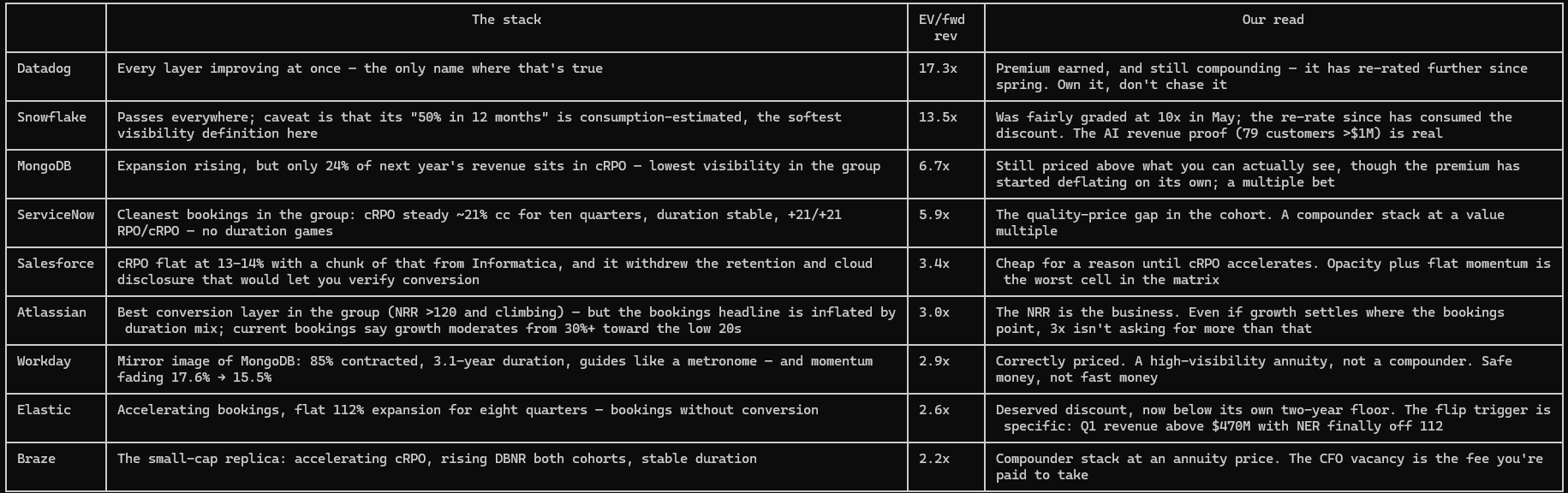
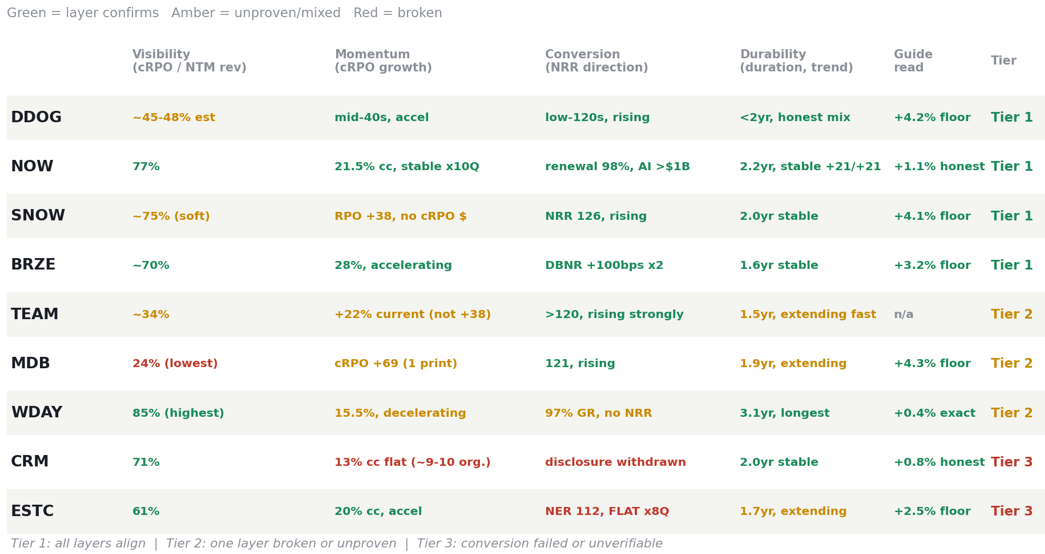
The market seems to grade the extremes correctly and misgrades the middle. Datadog’s premium and Elastic’s discount are both earned. The edge is concentrated in three names carrying Tier-1 or near-Tier-1 stacks at bottom-tier prices: ServiceNow, Braze, and Atlassian, where the discounts are attached to things the data says are artifacts (a guide’s optics, a CFO search, a duration shift) rather than to the businesses. And it’s concentrated on the other side in MongoDB, which trades at the richest multiple in the group outside the two confirmed re-raters, on the least contracted visibility a fine business priced as if its bookings were locked when they’re mostly usage decisions that haven’t happened yet. Turning that pattern into actual positions deserves its own section, after one more piece of evidence.
July just delivered the first confirmation print
The spring data could have been a one-window fluke. The first meaningful print since then says otherwise. On July 22, ServiceNow reported constant-currency subscription growth accelerating from 19% to 23% a real reacceleration, not a comp effect with the cRPO beat widening quarter over quarter, AI ACV crossing $1B ahead of the raised target, and the renewal rate improving to 98%. For calibration, Salesforce’s most recent print grew roughly 13%, with cRPO growth about the same. ServiceNow is growing at nearly twice the rate of the category’s largest incumbent, which tells you the reacceleration is share plus AI conversion, not a rising tide that lifts the whole group. That’s the other side of the recognition lag: the bookings the market sold in the spring are simply arriving in reported revenue, and the same sequence is queued across the cohort.
One note on timing, because the mechanism deserves it. The market that wrongly sold ServiceNow’s April guide wasn’t punished quickly, the stock went sideways for three months and lagged the S&P by about seven points before the July print paid the patience off. The recognition lag tells you what happens in fundamentals but doesn’t tell you when the tape agrees about future terminal value.
Where the risk/reward actually is
ServiceNow is the best total package in the space right now. At roughly 6.6x forward subscription revenue (fiscal-2026 basis, essentially unchanged since the July 22 print; about 5.9x on next-twelve-month total revenue) near the bottom of its six-month range the required-return math is unusually undemanding: a 10% annual return over three years needs an exit multiple of about 5.3x, and a 15% return needs about 6.1x. Both sit at or below today’s multiple. Said plainly, the stock clears a 15% hurdle without any re-rating, purely on the operating path and that operating path is the one the bookings already describe, since cRPO has grown 21-23% cc for ten straight quarters and revenue just converged up to it. Run the base case forward (subscription revenue toward $26B by fiscal 2029, multiple held near the low end of a reasonable range) and you get a mid-to-high-teens IRR with upside scenarios above 25%. The risk is real and specific: the 2027 margin-scaling promise doesn’t get tested until the January 2027 guide, three acquisitions in nine months flipped the balance sheet from $6.4B net cash to slight net debt, and if that guide holds margins flat again the market will re-read the whole story as an expensive roll-up, call it a bear case in the $75-85 area against roughly $100 today. What makes the risk/reward attractive anyway is the shape, the downside is about -20% on a dated, identifiable event, while the base case pays mid-teens annually and the bull case (margin inflection confirmed, multiple back toward 7.5x+) is a double over three years. Earlier tell if it’s going wrong will be the Q3 cRPO beat margin narrowing back toward 100 bps from 200.
Elastic is the most asymmetric single position, because the fail case is priced and the win case isn’t. You pay 2.6x forward revenue as the stock has now drifted below the 3x floor it held for two years, on no new information with roughly a 7% trailing free-cash-flow yield underneath. What you get for that: the bookings signal is already live (cRPO accelerated from 15% to 20%, non-current RPO up 43%, deferred revenue up 27% in one quarter), management just raised its long-term operating-margin target from over 20% to about 25%, and the hurdle math borders on absurd a 10% return requires roughly a 9% fiscal-2029 FCF margin against the 21.5% already guided. What’s missing is the confirmation: the expansion rate has to move off 112%, and the revenue print has to clear about $470M both testable at the late-August report. The reason this is a position rather than a watchlist item is the shape of failure is if conversion never comes, Elastic’s own two-year history says the stock drifts at a floor multiple with a cash yield, dead money, not a drawdown, while the success case pays the way our sequencing work says confirmation always pays: estimates and multiple at the same time, from 2.6x. You are being paid to wait in the one phase of the cycle where waiting is cheap.
Braze is the position our own framework says shouldn’t exist, which is exactly why it’s interesting. The sequence rule from the data is bookings turn, revenue follows, expansion confirms, multiple re-rates last. Braze has already completed the first three steps with four straight quarters of organic revenue acceleration, cRPO at 28% and rising, DBNR up 100 bps in both customer cohorts and the multiple simply hasn’t taken the fourth, sitting at 2.2x forward revenue, below where several decelerating peers trade and it has gotten cheaper since spring while the fundamentals improved. The discount has three visible causes, it’s small, the CFO seat is open, and the OfferFit acquisition muddies the reported numbers enough that the clean organic print (+27%) takes work to see. Every one of those is either temporary or cosmetic, and the CFO hire is a free catalyst with a date attached eventually. Meanwhile the setup that has paid all year repeats into late August. The company guided +22% against bookings running at +28%, and it has beaten its own guide by 2.3-5% eight straight times. The Risk is that at this size a single large-customer loss matters, the Decisioning Studio product that carries the AI story is still tiny, and small-cap software gets sold indiscriminately in risk-off tape. Size it accordingly but the ratio of stack quality to price is the best in the group.
Atlassian is the pay for the proven engine, accept the slower car position. What you’re buying is the single best conversion layer in the cohort with NRR above 120% and climbing for three quarters, Rovo customers expanding ARR at twice the rate of non-Rovo plus 800 bps of margin expansion in a year, at 3.0x forward revenue, near the bottom of its historical range. The honest accounting cuts the growth expectation as current bookings grew about 22%, so the 32% headline growth likely moderates toward the mid-20s as Data Center end-of-life comps and pull-forwards wash out. The reason it’s still attractive is that 3x isn’t asking for 32% it isn’t really asking for 25% — and the duration extension that inflated the headline RPO is, read correctly, customers signing multi-year cloud migration commitments, which is durability wearing the costume of a red flag. The break is NRR rolling back under 120 as that’s the engine, and there’s no version of this position that survives it.
The funding leg is MongoDB, and it’s a relative call, not a business short. The company is fine expansion rising, Atlas growing 29%+, federal optionality real. The position is against the price: 6.7x forward revenue already down a fifth since spring, so the premium has begun deflating on its own still attached to the least contracted visibility in the group. Only about 24% of the next twelve months sits in RPO, which means at roughly ServiceNow’s multiple you’re getting a quarter of ServiceNow’s contracted coverage. Its own base-case math per our model works out to roughly a 9-10% IRR (the lowest in the set), and the +88% RPO headline that decorates the story is one-fifth duration mix. Short the certainty premium at the name where certainty is least contracted, and use it to fund the names where certainty is literally on the balance sheet.
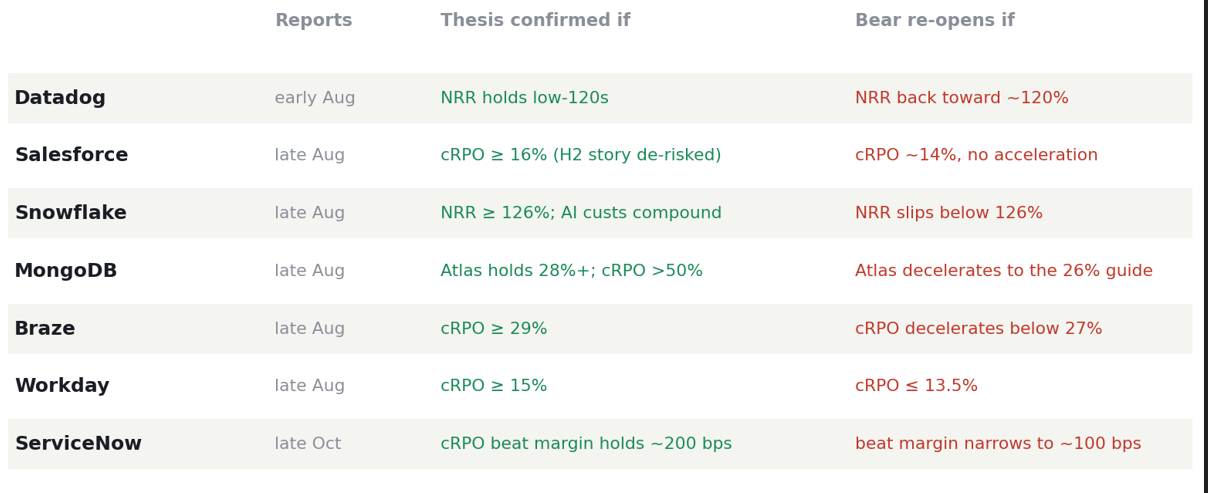
Datadog is the best business in the group and I wouldn’t chase it. It has re-rated further since spring to 17.3x, which is full confirmation pricing and the return from here rides on growth durability rather than any re-rate, and the unresolved question of its largest customer’s spending is the swing factor at exactly the multiple where swing factors hurt. Snowflake has re-rated from about 10x in May to 13.5x, the market has now paid for most of its confirmation, and the gross-margin line, where AI products dilute and an undisclosed AWS offset is doing quiet work, matters even more at this price; fine to hold, wrong price to initiate. Workday is safe carry, not opportunity: 85% of next year contracted and a guide you can set a watch by, but our own warning pattern around bookings fading while retention stays pristine is currently describing it, so it needs cRPO at 15%+ in late August to stay interesting even as carry. And Salesforce is a cheap option on one number: cRPO at 16% or better in late August makes the whole H2 story credible and the stock works from 3.4x; anything less, and you’re holding a company that stopped showing you the data you’d need to get comfortable. Every one of these has its verdict date inside the next two earnings cycles, which is the final attraction: this isn’t a thesis that asks for faith. It asks for August and October.
What would prove the bears were early, not wrong
The intellectually honest version of the bear case is no longer agents shrink seats, but rather that the the committed AI capacity won’t convert to consumption and ease of substitution will disrupt current players. That version is still live, and it has real evidence to point at. Salesforce’s cRPO grew just 14% with no acceleration and its $1B of Agentforce ARR is heavily committed capacity, cash realization lags by quarters, and the company withdrew cloud-level disclosure in the same quarter it touted the AI number. That’s the one name in the group simultaneously claiming an AI inflection and reducing the data you’d need to verify it. Amplitude is the other cautionary print: AI hit its cost line before its revenue line, and the profit guide got cut. So here is the falsifier, stated in advance. If two or more of the consumption-transition names print decelerating cRPO in the August cycle while the AI consumption metrics flatten, the commitments were capacity that doesn’t convert, and the seat-compression bears were early rather than wrong. Datadog reports in early August and sets the tone, Salesforce, Snowflake, MongoDB, and Braze follow in late August. That cycle is the second data point on everything above, which is exactly why the window to act on the first data point is now.
Great analysis 🤘